
House Cleaning as a System: Designing a Living Environment That Self-Regulates
At Clean On The Go, we approach house cleaning as more than a recurring chore. We treat it as a dynamic system that can be engineered to sustain itself with minimal friction. Instead of chasing mess after it appears, we build environments where cleanliness becomes the default state. This shift transforms how homes function, how time is spent, and how mental clarity is maintained.
5/9/20263 min read
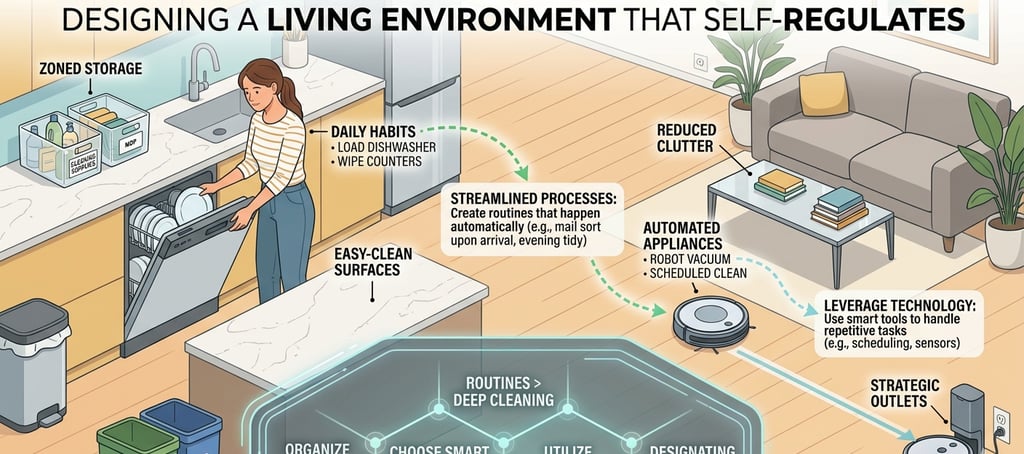
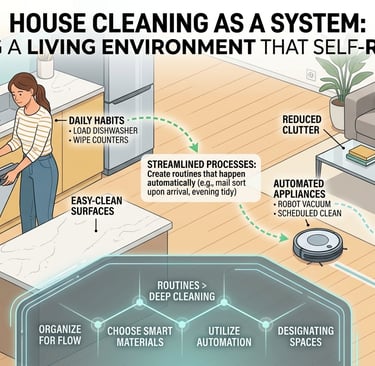
House Cleaning as a System
At Clean On The Go, we approach house cleaning as more than a recurring chore. We treat it as a dynamic system that can be engineered to sustain itself with minimal friction. Instead of chasing mess after it appears, we build environments where cleanliness becomes the default state. This shift transforms how homes function, how time is spent, and how mental clarity is maintained.
The Hidden Mechanics of Mess
Most homes are not inherently messy. They are structurally inefficient. Items lack defined zones, surfaces attract clutter due to poor spatial logic, and cleaning routines are reactive rather than predictive. When we step into a home, we do not just clean. We audit movement patterns, storage behaviors, and surface usage.
For example, a cluttered kitchen counter is rarely about laziness. It is often the result of misplaced storage hierarchy. If daily use items are stored too far from their point of use, they migrate to the nearest surface. Our job is to realign that system so the environment supports clean behavior without effort.
Cleaning as Environmental Engineering
We design cleaning strategies based on three core principles:
1. Flow Optimization
Every home has movement pathways. We study how residents move through rooms and identify friction points. Cleaning becomes more effective when these pathways are unobstructed and logically arranged.
2. Surface Economics
Not all surfaces should be treated equally. High traffic surfaces require different cleaning frequencies and materials compared to low interaction zones. We categorize surfaces into active, passive, and dormant, then assign cleaning protocols accordingly.
3. Behavior Anchoring
Instead of relying on discipline, we create environmental triggers. For instance, placing microfiber cloths in strategic locations encourages quick wipes before buildup occurs. Small design decisions reduce the need for large cleaning efforts later.
The Concept of Micro Cleaning Cycles
Traditional cleaning relies on large, time-consuming sessions. We replace this with micro cleaning cycles. These are short, targeted interventions embedded into daily life.
A well-designed home allows for:
• 30 second surface resets
• 2 minute zone corrections
• 5 minute high impact refreshes
When these micro cycles are integrated, the need for deep cleaning reduces significantly. Our role is to establish the foundation that makes these cycles intuitive.
Material Intelligence in Cleaning
Cleaning is not just about effort. It is about understanding materials. Different surfaces respond to different chemical compositions, textures, and techniques.
We tailor our approach based on:
• Porosity levels of materials
• Reaction to moisture and heat
• Long term wear patterns
This prevents damage while enhancing longevity. A properly cleaned surface should not just look good today. It should maintain integrity over years.
Psychological Impact of Structured Cleanliness
A clean home is often associated with comfort, but the deeper impact lies in cognitive performance. Disorganized environments create subtle mental load. Every misplaced object demands attention, even subconsciously.
By implementing structured cleaning systems, we help reduce:
• Decision fatigue
• Visual noise
• Background stress
Clients often report improved focus and better time management once their environment is optimized. This is not incidental. It is a direct result of reducing environmental resistance.
Adaptive Cleaning for Modern Lifestyles
Homes today are multi-functional spaces. They serve as offices, relaxation zones, and social environments. Static cleaning routines do not adapt well to this complexity.
We build adaptive cleaning frameworks that respond to:
• Work from home setups
• High usage zones during specific hours
• Seasonal behavioral shifts
This ensures the cleaning strategy evolves with the household rather than becoming obsolete.
The Clean On The Go Method
Our approach is structured yet flexible. We do not impose generic cleaning routines. We develop tailored systems that align with how each home operates.
Our process includes:
• Spatial analysis of the home
• Identification of inefficiencies
• Implementation of system-based cleaning protocols
• Continuous refinement based on usage patterns
We are not just maintaining cleanliness. We are engineering it.
Redefining What a Clean Home Means
A clean home is not one that looks perfect after hours of work. It is one that remains consistently functional with minimal intervention. The difference lies in design, not effort.
At Clean On The Go, we focus on building homes that sustain cleanliness naturally. When the system is right, cleaning becomes effortless. When cleaning becomes effortless, it becomes consistent. And consistency is what truly defines a clean home.
Feel free to get in touch with us
We love our customers, so feel free to contact us during normal business hours.
Clean on the Go
📍180 rue Joseph-Carrier, #124
Vaudreuil-Dorion,
Quebec, Canada, J7V 3V1
📍3235 Av. de la Gare,
Mascouche,
Quebec, Canada, J7K 3C1
Contact
Hours
Monday - Friday: 9am – 5pm
Saturday - Sunday: Closed
New Areas
Terrebonne, Repentigny, Mascouche and more
Service Areas
West Island, Vaudreuil-Soulanges and Surrounding Areas.
Vaudreuil-Dorion - Hudson - Saint-Lazare - Les Coteaux - Rigaud - Notre-Dame de l'ile Perrot - Pincourt - Saint Anne de Bellevue - Senneville - Baie-D'Urfe - Kirkland - Beaconsfield - Pointe Claire - Dollard des Ormeaux - Pierrefonds - L'ile Bizard - Sainte-Genevieve - Dorval and more.